
B01
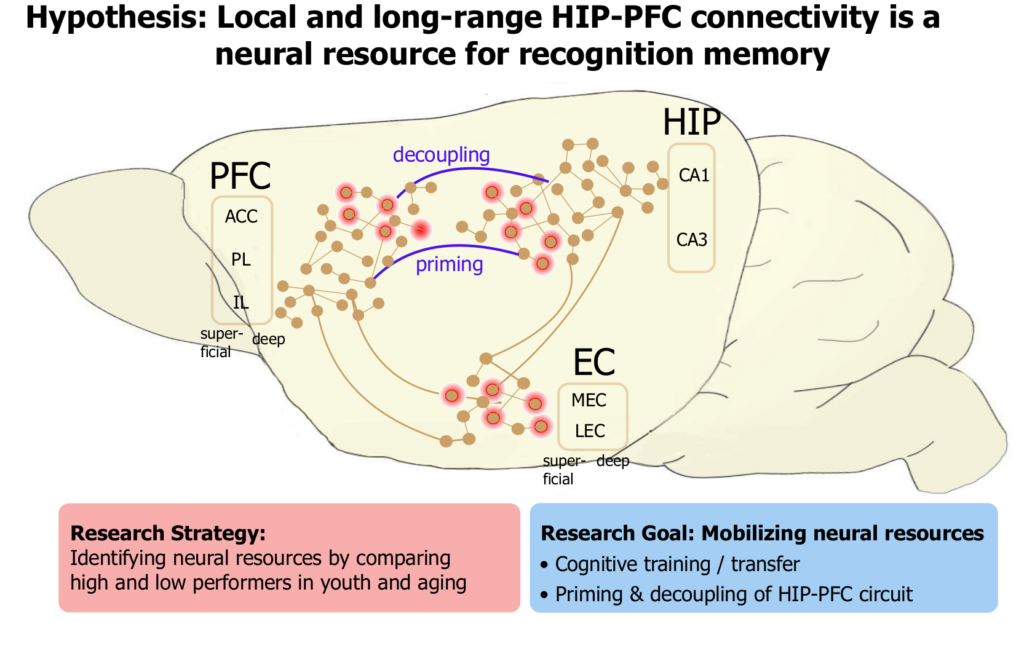
Recognizing objects, environments and people in the everyday life allows us to orient ourselves in a complex world. This ability differs between individuals and changes at different stages of life. Our goal is to understand how these differences are linked to neuronal networks within and between brain areas crucial for cognition: the medial temporal lobe (MTL) areas and the prefrontal cortex (PFC).
Principal Investigators & Co-Workers
Dr. Matthias Prigge

Prof. Dr. Magdalena Sauvage

Dr. Erika Atucha
Julia Buescher

Halla Mulla Osman
The MTL areas and the PFC are neuronal hubs for recognition memory
Damage to the MTL leads to severe memory deficits as seen for example in aging. The MTL includes the hippocampus (HIP), the entorhinal, the perirhinal, and the postrhinal cortices. The PFC is thought to recognize abstract connections between individual memories. We focus on how specific subsets of neurons of these brain regions are recruited into ‘engrams’ to support memory formation and serve memory retrieval, what is the relationship between these neuronal networks and how this relationship evolves with aging
What is an engram and how does it change with age?
We aim at identifying the characteristics of the neuronal ensembles engaged during recognition memory and the cellular mechanisms underlying their formation. For this purpose, we investigate how neurons within the MTL and the PFC connect to form so-called ‘engrams’, whether and how engrams from these distant brain areas interact with each other to improve recognition memory and how this relationship progresses in the old age.
A vast interindividual differences in the ability to remember
Why some have a better memory than others is not yet well understood. In some cases pathologies such as neurodegenerative diseases play a role. However, even in healthy individuals, the ability to recall a place, an individual or other features of a memory can vary from poor to exceptional. This difference might reflect the existence of yet not fully exploited resources that could be harvested to improve performance. Such a range of performance is also observed in aged populations for which memory deficits but also memory performance comparable to that of young subjects are reported, as is the case for ‘Superagers’. Interestingly such differences are also reported in a various range of species, including rodents. Previous studies have suggested that the degree of activity of neurons prior to the formation of a memory are critical in determining whether a neuron will be integrated into an engram (Josselyn et al. Science 2020). We hypothesize that the size of the engram and the relationship between the engrams formed in the MTL and the PFC, i.e. the communication between these engrams, might also play a key role to achieve optimal recognition memory performance.
The goals of our project
We are studying whether connectivity within and between the MTL and the PFC might constitute a resource for recognition memory. For this, we investigate: which and how specific subsets of neurons of these areas are recruited into ‘engrams’ to support memory formation and enable memory retrieval, the cellular mechanism underlying the formation of these engrams and the relationship between MTL and PFC engrams. We do so by identifying key interindividual differences between poor and good performers on object recognition memory tasks using engram mapping (Beer and Vavra, Plos Biology, 2018) and in-vitro electrophysiological techniques. In addition, we investigate how these mechanisms evolves with age and implement behavioral and optogenetic manipulations to improve/rescue memory performance, i.e. cognitive training/optical priming of brain-wide axonal connections (Klavir & Prigge et al, Nature Neuroscience 2017).
How to identify neuronal engrams
We use viral neuronal tracers to map connections between the prefrontal cortex, supramammillary nucleus, and hippocampus. In order to find out whether the interconnected nerve cells contain orexin receptors, they are isolated using laser microdissection and their mRNA profile is examined. In addition, we use the RNAScope technique to display the expression of orexin receptors in the individual brain areas with high spatial resolution.
Cognitive training, transfer and priming of HIP-PFC projections
We will investigate how a disruption of the circadian rhythm (disrupted sleep, jet lag) affects learning and memory and which role the hippocampus, supramammillary nuclei and prefrontal cortex play in these processes. We will also evaluate the impact of the local reduction of orexin receptors on learning and memory. Then we will test how the intranasal application of orexin and, as a complement, a blockade of orexin receptors affects cognitive performance and the formation of cellular memory traces in the hippocampus.

Outlook
Through close collaborations with CRC1436 subprojects, we seek to understand the fundamental mechanisms underlying recognition memory and to identify and unlock available resources to improve/rescue performance. In the future, we aim at adapting to humans the cognitive manipulations that will be successful in delaying cognitive decline in aging and/or improve memory function in the present project and to develop non-invasive brain stimulation protocols achieving the same goals.
Publications of the project B01
Shih-Pi Ku, Erika Atucha, Nico Alavi, Halla Mulla-Osman, Rukhshona Kayumova, Motoharu Yoshida, Jozsef Csicsvari, Magdalena M. Sauvage
Erika Atucha, Shih-Pi Ku, Michael T. Lippert, Magdalena M. Sauvage
Grande, X., Sauvage, M. M., Becke, A., Duzel, E., & Berron, D